

Continuous Integration with GitHub Actions
Last updated on 2026-10-06 | Edit this page
Estimated time: 45 minutes
Overview
Questions
- How can I automate the testing of my code?
- What are GitHub Actions?
Objectives
- Understand the concept of continuous integration
- Learn how to use GitHub Actions to automate the testing of your code
Continuous Integration
Continuous Integration (CI) is the practice of automating the merging of code changes into a project. In the context of software testing, CI is the practice of running tests on every code change to ensure that the code is working as expected. GitHub provides a feature called GitHub Actions that allows you to integrate this into your projects.
In this lesson we will go over the basics of how to set up a GitHub Action to run tests on your code.
This lesson assumes a working knowledge of Git and GitHub. If you get stuck, you may find it helpful to review the Research Coding Course’s material on version control
Setting up your project repository
- Create a new repository on GitHub for this lesson called “python-testing-course” (whatever you like really). We recommended making it public for now.
- Clone the repository into your local machine using
git clone <repository-url>or via Github Desktop. - Move over all your code from the previous lessons into this repository.
- Commit the changes using
git add .andgit commit -m "Add all the project code" - Create a new file called
requirements.txtin the root of your repository and add the following contents:
pytest
numpy
snaptol
This is just a list of all the packages that your project uses and will be needed later. Recall that each of these are used in various lessons in this course.
Nowadays it is usually preferable to list dependencies in a file
called pyproject.toml, which also allows Python packages to
be installed and published. Look out for our upcoming course on
reproducible environments to learn more!
Now we have a repository with all our code in it online on GitHub.
Creating a GitHub Action
GitHub Actions are defined in yaml files – a structured
text file which is commonly used to pass settings to programs. They are
stored in the .github/workflows directory in your
repository.
- Create a new directory in your repository called
.github - Inside the
.githubdirectory, create a new directory calledworkflows - Inside the
workflowsdirectory, create a new file calledtests.yaml
This test.yaml file is where you will tell GitHub how to
run the tests for your code.
Let’s add some instructions to the tests.yaml file:
YAML
# This is just the name of the action, you can call it whatever you like.
name: Tests (pytest)

# This sets the events that trigger the action. In this case, we are telling
# GitHub to run the tests whenever a push is made to the repository.
# The trailing colon is intentional!
on:
  push:

# This is a list of jobs that the action will run. In this case, we have only
# one job called test.
jobs:

  # This is the name of the job
  test:

    # This is the environment that the job will run on. In this case, we are
    # using the latest version of Ubuntu, however you can use other operating
    # systems like Windows or MacOS if you like!
    runs-on: ubuntu-latest

    # This is a list of steps that the job will run. Each step is a command
    # that will be executed on the environment.
    steps:

      # This command tells GitHub to use a pre-built action. In this case, we
      # are using the actions/checkout action to check out the repository. This
      # just means that GitHub will clone this repository to the current
      # working directory.
      - uses: actions/checkout@v6

      # This is the name of the step. This is just a label that will be
      # displayed in the GitHub UI.
      - name: Set up Python 3.12
        # This command tells GitHub to use a pre-built action. In this case, we
        # are using the actions/setup-python action to set up Python 3.12.
        uses: actions/setup-python@v6
        with:
            python-version: "3.12"

      # This step installs the dependencies for the project such as pytest,
      # numpy, pandas, etc using the requirements.txt file we created earlier.
      - name: Install dependencies
        run: |
          python -m pip install --upgrade pip
          pip install -r requirements.txt

      # This step runs the tests using the pytest command.
      - name: Run tests
        run: |
          pytest
This is a simple GitHub Action that runs the tests for your code whenever code is pushed to the repository, regardless of what was changed in the repository or which branch you push too. We’ll see later how to run tests only when certain criteria are fulfilled.
Upload the workflow to GitHub
Now that you have created the tests.yaml file, you need
to upload it to GitHub.
- Commit the changes using
git add .andgit commit -m "Add GitHub Action to run tests" - Push the changes to GitHub using
git push
This should trigger a workflow on the repository. While it’s running, you’ll see an orange circle next to your profile name at the top of the repo. When it’s done, it’ll change to a green tick if it finished successfully, or a red cross if it didn’t.
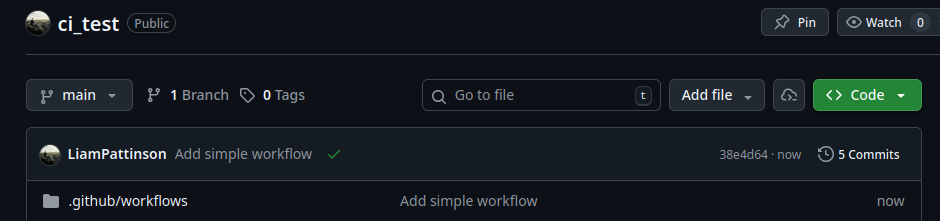
You can view all previous workflow runs by clicking the ‘Actions’ button on the top bar of your repository.

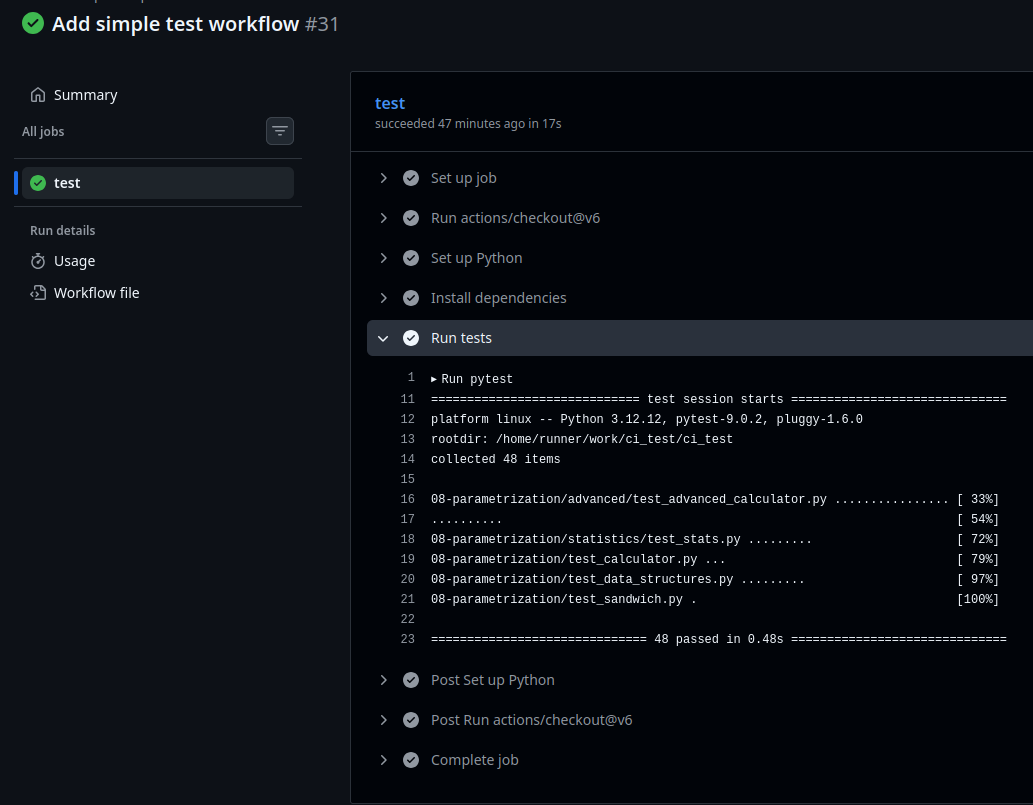
If you click on the orange circle/green tick/red cross, you can also view the individual stages of the workflow and inspect the terminal output.
Testing across multiple platforms
A very useful feature of GitHub Actions is the ability to test over a wider range of platforms than just your own machine:
- Operating systems
- Python versions
- Compiler versions (for those writing C/C++/Fortran/etc)
We can achieve this by setting
jobs.<job_id>.strategy.matrix in our workflow:
YAML
jobs:
  test:
    strategy:
      matrix:
        python_version: ["3.12", "3.13", "3.14"]
        os: ["ubuntu-latest", "windows-latest"]
    runs-on: ${{ matrix.os }}
    steps:
      ...
Later in the file, the setup-python step should be
changed to:
YAML
      - name: Set up Python ${{ matrix.python_version }}
        uses: actions/setup-python@v6
        with:
            python-version: ${{ matrix.python_version }}
By default, all combinations in the matrix will be run in separate
jobs. The syntax ${{ matrix.x }} inserts the text from the
x list for the given matrix job.
Upgrade the workflow to run across multiple platforms
- Make the changes above to your workflow file, being careful to get the indentation right!
- Commit the changes and push to GitHub.
- Check the latest jobs in the Actions panel.
You should see that a total of 6 jobs have run, and hopefully all will have passed!
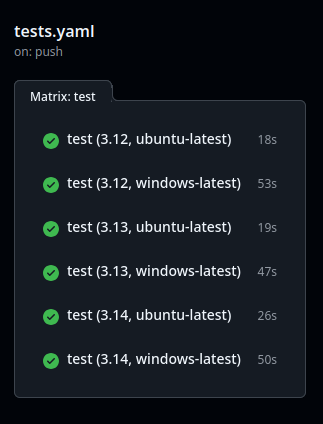
This ensures that code that runs on your machine should, in theory, run on many other peoples’ machines too. However, it’s best to restrict the matrix to the minimum number of necessary platforms to ensure you don’t waste resources. You can do so with a list of exclusions:
Running on other events
You may have wondered why there is a trailing colon when we specify
push: at the top of the file. The reason is that we can
optionally set additional conditions on when CI jobs will run. For
example:
YAML
on:
  push:
    # Only check when Python files are changed.
    # Don't need to check when the README is updated!
    paths:
      - '**.py'
      - 'pyproject.toml'
    # Only check when somebody raises a push to main.
    # (not recommended in general!)
    branches: [main]
Doing this can prevent pointless CI jobs from running and save resources.
You can also run on events other than a push. For example:
YAML
on:
  push:
    paths:
      - '**.py'
      - 'pyproject.toml'
  # Run on code in pull requests.
  pull_request:
    paths:
      - '**.py'
      - 'pyproject.toml'
  # This allows you to launch the job manually
  workflow_dispatch:
There is an important subtlety to running on
pull_request versus push:
-
pushruns directly on the commits you push to GitHub. -
pull_requestruns on the code that would result after the pull request has been merged into its target branch.
In collaborative coding projects, it is entirely possible that
main will have diverged from your branch while you were
working on it, and tests that pass on your branch will fail after the
merge. For this reason, it’s recommended to always include both
push and pull_request in your testing
workflows.
Running on pull requests (advanced)
Can you engineer a situation where a CI job passes on
push but fails on pull_request?
- Write a function to a new file, commit the changes, and push it to
your
mainbranch. It can be something as simple as:
- Switch to a new branch
my_branchwithgit switch -c my_branch, and write a test for that function in a new file:
PYTHON
# file: test_message.py
from message import message

def test_message():
assert message() == "foo"- Check that the test passes, and commit it.
- Push
my_branchto GitHub withgit push -u origin my_branch, but don’t raise a pull request yet. - Return to your
mainbranch, and modify the function being tested:
- Push the changes to
main. - Now raise a pull request from
my_branchintomain.
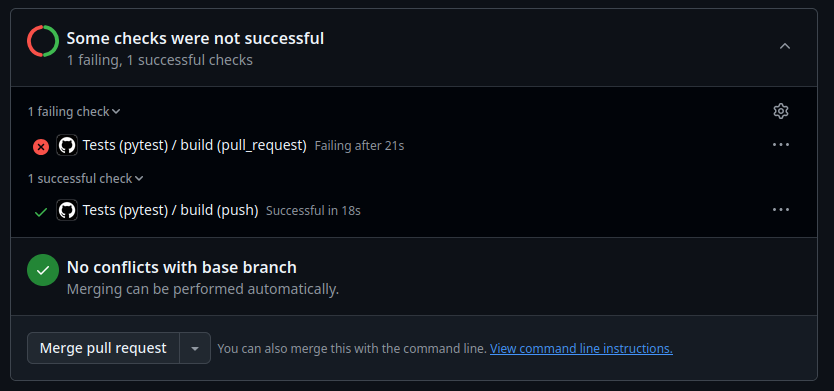
The code on the new branch will be testing the old implementation,
and should pass. However, following the merge, the test would fail. This
results in the push test passing, and the
pull_request test failing.
Keypoints
So now, when you or your team want to make a feature or just update the code, the workflow is as follows:
- Create a new branch for the feature
- Write the code for the feature
- Write tests for the feature
- Push the code to GitHub
- Create a Pull Request
- Wait for the tests to pass or fail
- If the tests pass, merge the code into the main branch or fix the code if the tests fail
This will greatly improve the quality of your code and make it easier to collaborate with others.
- Continuous Integration (CI) is the practice of automating the merging of code changes into a project.
- GitHub Actions is a feature of GitHub that allows you to automate the testing of your code.
- GitHub Actions are defined in
yamlfiles and are stored in the.github/workflowsdirectory in your repository. - You can use GitHub Actions to ensure your tests pass before merging
new code into your
mainbranch.